By Aad van der Werf
‘Philosophers have probably drunk more than their fair
share of wine; but they have not had a fair share in the words
written about it.’ Roger Scruton, distinguished philosopher
and writer, and also wine correspondent for the 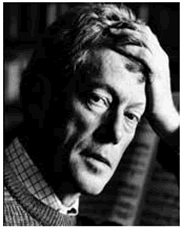 New
Statesman in his contribution to Questions of Taste. An excerpt: New
Statesman in his contribution to Questions of Taste. An excerpt:
In particular, they have largely avoided discussing the most
important philosophical issue with which wine acquaints us,
which is that of intoxication. Questions immediately arise.
What exactly is intoxication? Is there a single phenomenon that
is denoted by this word? Is the intoxication induced by wine
an instance of the same general condition as the intoxication
induced by whisky say, or that induced by cannabis? And is “induced”
the right word in any or all of the familiar cases?
Furthermore there is a real question about the relation between
the intoxication that we experience through wine, and the state
of drunkenness. The first is a state of consciousness, whereas
the second is a state of unconsciousness – or which tends
towards unconsciousness. Although the one leads in time to the
other, the connection between them is no more transparent than
the connection between the first kiss and the final divorce.
Non-rational animals sniff for information, and are therefore
interested in smells. They also discriminate between the edible
and the inedible on grounds of taste. But they relish neither
the smell nor the taste of the things that they consume. For
relishing is a reflective state of mind, in which an experience
is held up for critical inspection.
Aquinas distinguished the cognitive senses of sight and hearing
from the non-cognitive senses of taste and smell, arguing that
only the first could provide the perception of beauty.
Visual experience reaches through the “look” of
a thing to the thing that looks. I don’t “sniff
through” the smell to the thing that smells. One conclusion
to draw from that is that smells are ontologically like sounds
– not qualities of the objects that emit them but independent
objects.
If asked to choose therefore I would say, for philosophical
reasons, that the intoxication that we experience in wine is
a sensory but not an aesthetic experience, whereas the intoxication
of poetry is aesthetic through and through. Still, there is
no doubt that the intoxicating quality that we taste in wine
is a quality that we taste in it, and not in ourselves.
My excitement at a football match is not a physiological condition
that could have been produced by a drug. It is directed towards
the game: it is excitement at the spectacle and not just excitement
caused by the spectacle; it is an effect directed at its cause.
And that is true too of the wine.
Visual experience is a representation of reality. Now taste
and smell are not like that, as I noted above. I might say of
the ice-cream in my hand that it tastes of chocolate or that
it tastes like chocolate, but not that I taste it as chocolate,
as through taste were itself a form of judgment. Winespeak is
in some way ungrounded, for it is not describing the way wine
is, but merely the way it tastes. And tastes are not representations
of the objects that possess them.
There is more at stake when it comes to taste in wine than
mere taste, and the adage that de gustibus non est disputandum
is as false here as it is in aesthetics.
In particular we should distinguish between four basic kinds
of stimulant:
1. Those which please, and which have mental effects, but which
do not alter the mind.
Tobacco is probably the example most familiar to us.
2. Stimulants which have mind-altering effects, but which do
not bring any pleasure in the consumption of them.
The most obvious examples of this are drugs that you swallow
whole like Ecstasy, or drugs that you inject like heroin.
3. Stimulants that have mind altering effects but which give
pleasure in the act of consuming them.
The two most interesting cases are cannabis and alcohol. I refer
to alcohol in general and not just to wine.
4. Stimulants that have mind-altering effects which are in
some way internally related to the experience of consuming them.
The example, of course, is wine, and that is what I meant earlier
in referring to the intoxicating quality of the taste.
Wine is not simply a shot of alcohol, and must never be confused
in its effect with spirits or even with cocktails. Wine is not
a mixed drink but a transformation of the grape. The transformation
of the soul under its influence is merely the continuation of
another transformation that began maybe fifty years earlier
when the grape was first plucked from the vine.
When we raise a glass of wine to our lips, therefore, we are
savouring an ongoing process: wine is a living thing, the last
result of other living things, and the progenitor of life in
us.
It would be an exaggeration to make too much of the comparison,
ancient though it is, between the erotic kiss and the sipping
of wine. Nevertheless, it is not an exaggeration, but merely
a metaphor, to describe the contact between the mouth and the
glass as a face to face encounter between you and the wine.
The ancient proverb tells us that there is truth in wine. The
truth lies not in what the drinker perceives but in what, with
loosened tongue and easier manners, he reveals. It is “truth
for others”, not “truth for self”. The characteristic
effect of wine, when drunk in company, includes an opening out
of the self to the other, a conscious step towards asking and
offering forgiveness: forgiveness not for acts or omissions,
but for the impertinence of existing. That is one way of understanding
the Christian doctrine of trans-substantiation, itself a survival
of the Greek belief that Dionysus is actually in the wine and
not just the cause of it.
First, tastes are not qualities in the way that colours are.
The taste can be there without the substance, as when I have
a taste in the mouth, but have swallowed nothing. The taste
is in the mouth in something like the way the smell is in the
air or the sound is in the room. Tastes belong with smells and
sounds in the ontological category of secondary objects.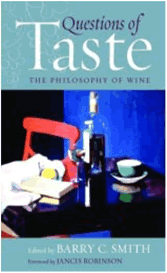
Those who conjure with the magic names of Burgundy, Bordeaux
and the Rhine and Moselle are not just showing off: they are
deploying the best and most reliable description of a cherished
taste, which is inseparable from the idea and the history of
the settlement that produced it. The Ancient Egyptians, incidentally,
while they often labeled wines with the place of their production,
and would trade with all the suppliers around the Mediterranean,
would classify wines by their social function. Archeologists
have recorded amphorae labeled as “wine for first-class
celebrations”, “wine for tax collection day”,
“wine for dancing”, and so on. It is easy to imagine
a tasting in which the punter holds the glass to his nose, takes
a sip and then says “Burgundy”; rather more difficult
to imagine him saying “tax collection”. Why is that?
Now it seems to me that the act of settling, which is the origin
of civilization, involves both a radical transition in our relation
to the earth – the transition known in other terms as
that from hunter-gatherer to farmer – and also a new sense
of belonging. The settled people do not belong only to each
other: they belong to a place, and out of that sense of shared
roots there grow the farm, the village and the city. At some
level, I venture to suggest, the experience of wine is a recuperation
of that original cult whereby the land was settled and the city
built.
Nothing else that we eat or drink comes to us with such a halo
of significance, and cursed be the villains who refuse to drink
it.
Excerpt by
Aad van der Werf
www.draagvlakbv.nl
Further excerpts will follow.
Copyright by : FlyingWineWriter | Jan Rook | Design by: Paula Rook
|

